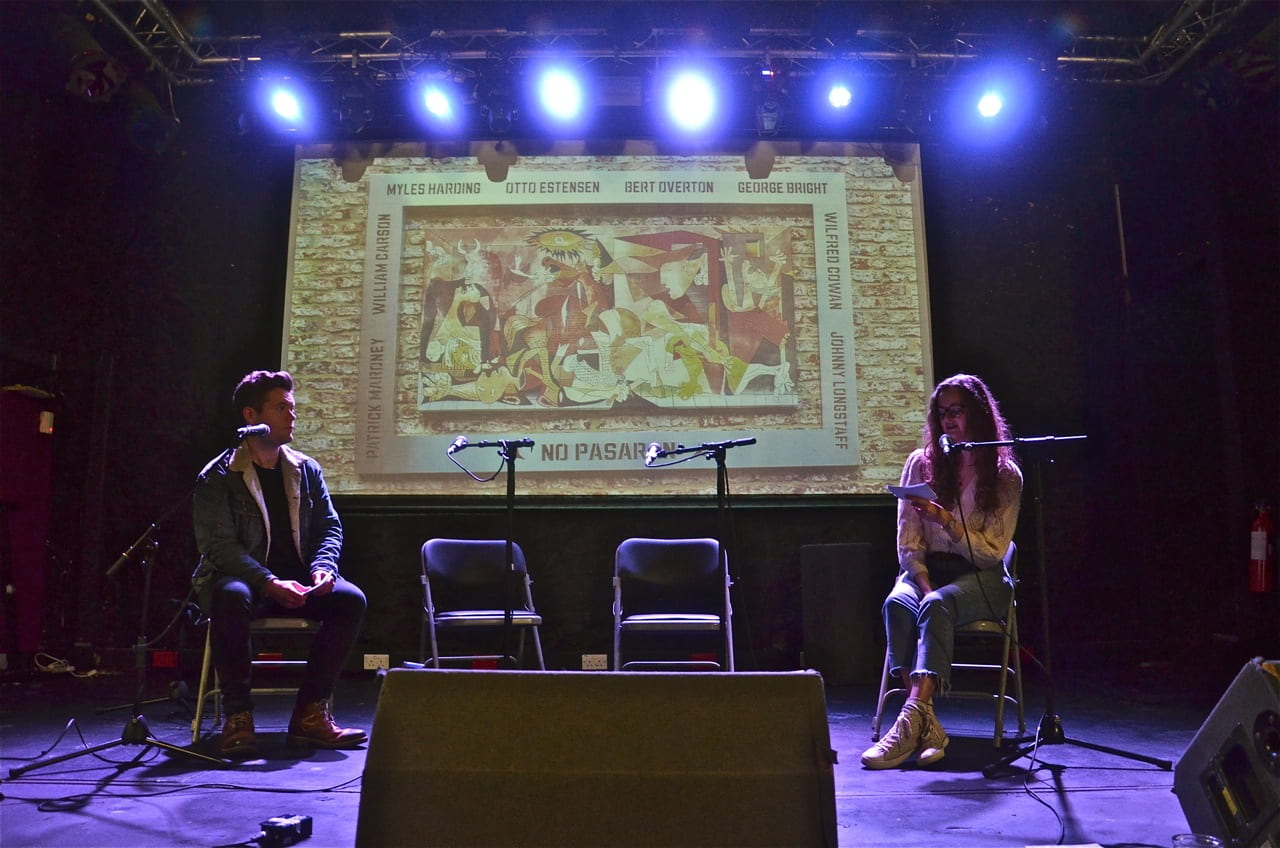
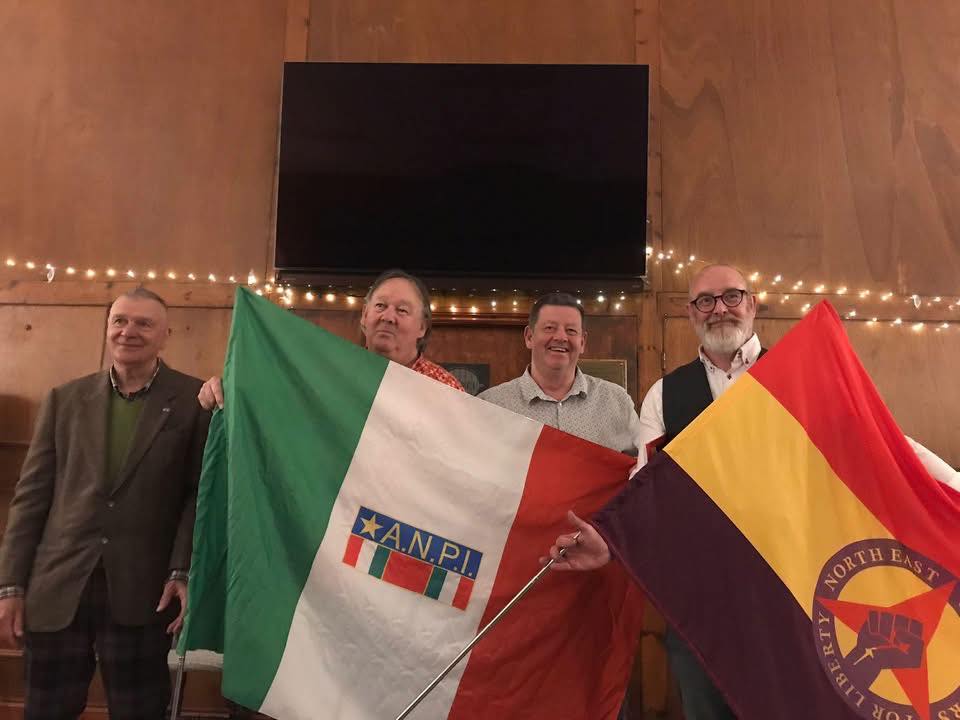
On Saturday 14th February 2026, in Stockton, in collaboration with our colleagues in the Madrid-based AABI Friends of the International Brigades, Alan Warren and Porta de la Historia, the Kfsr EV Deutschland; the German Friends of the International Brigade and with the support of Carl and his staff at The Olive Branch | Stockton-on-Tees , we marked the anniversary of the Battle of Jarama; the first action of the British Battalion of the XV International Brigade.
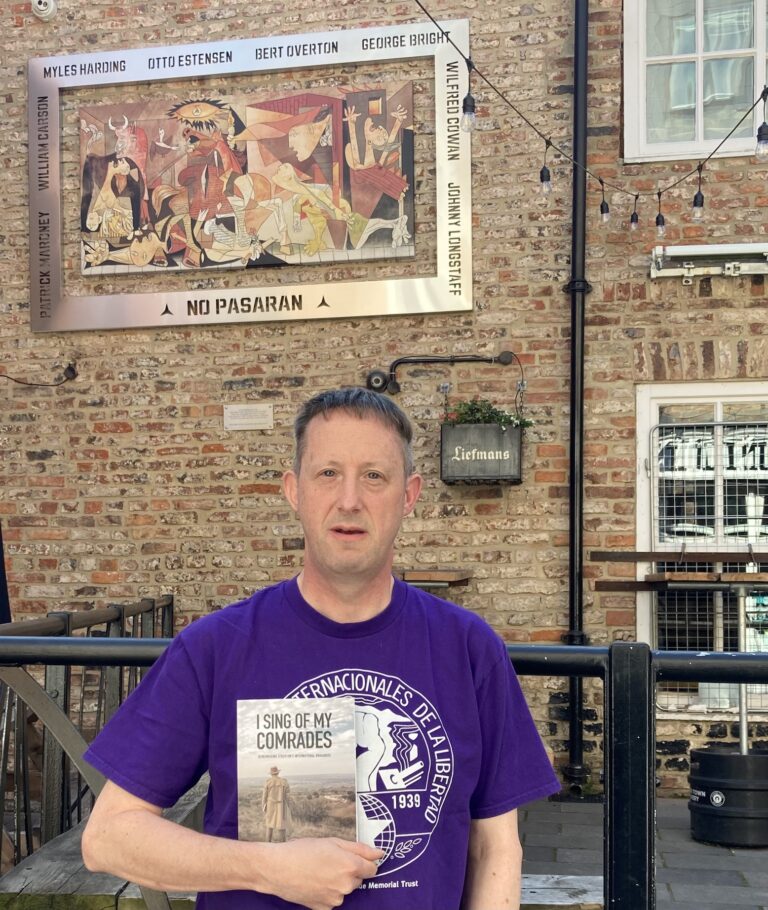
 The commemoration was held outside The Olive Branch,in the Wasps Nest Yard, at our magnificent Stockton International Brigade Memorial, which hangs on the recently opened The Songbird (previously named The Wasps Nest). Unlike last year when the commemoration was held in Middlesbrough we had some shelter from the wind, it was however equally as cold.
 Of the thirty-two Teesside born volunteers who served in the International Brigade during the Spanish Civil War thirteen fought at Jarama in 1937. On 12th February 1937 the British Battalion of the XV International Brigade faced its first battle. By the evening of the first day, the 600-strong Battalion had been reduced to 250 men. In the afternoon of 13th February, Bert Overton of Stockton took command of the British Battalion and led them until reinforcements arrived on the morning of the 14th February.
Four Teesside volunteers lost their lives at Jarama; George Bright and David Halloran were killed in action, whilst Thomas Carter and John Unthank died later as a result of wounds sustained in battle. All four are named on the Teesside International Brigade memorial, now in Middlesbrough Town Hall, we remembered:
George Bright joined the Communist Party on its foundation in 1921; he was a leading activist in the National Unemployed workers movement (NUWM); Leading the Stockton contingent in the 1932 and 1934 Hunger Marches. George demonstrated against the British Union of Fascists in Stockton in 1933 and Hartlepool in 1934 and later took part in the Battle of Cable Street in 1936. He arrived in Spain in December 1936 and as a senior Party organiser he was assigned to the political staff. George died on 12th February 1937 after joining his comrades on the front line.
Thomas Carter was the Communist Party district organiser for Hartlepool, he chaired the Party district committee and, like George Bright, he was very active prior to Spain; he led the Hartlepool NUWM and with his great friend Ron Dennison he demonstrated against the British Union of Fascists when they visited Darlington, Hartlepool, Middlesbrough and Stockton. Thomas Carter died of the wounds he sustained on during the Battle of Jarama on 27th February 1937.
David Holloran was a Communist Party member, and like the others he demonstrated against the British Union of Fascists when they visited his home town of Middlesbrough, as well as Darlington, Hartlepool and Stockton. David was enlisted into the British Battalion on 17th February 1937, tragically he was killed just ten days later on 27th February. In February 2024 a message from Denise, Helene and Maureen; the granddaughters of David Holloran, was laid at the new Jarama battlefield memorial.
John Unthank arrived in Spain on 7th January, just three weeks after his younger brother Alex, both had been in the Young Communist League and were now Communist Party members. Both had already opposed Fascism at home, demonstrating against the BUF in Hartlepool, Middlesbrough and Stockton. Both Unthank brothers were seriously wounded at the Battle of Jarama, Alex recovered and was repatriated whilst John died of the wounds he sustained at Jarama in April 1937.
George Brown reports on the memorial service held by the members of the British Battalion in April 1937. Four of the Stockton volunteers will have taken part in the memorial service with a fifth, George Bright, being commemorated.
On the afternoon of 29 April only a few of the comrades of the Battalion are in the trenches keeping guard. The rest are a few yards behind the trenches, lined up in military formation. They are holding a memorial service to their comrades who have fallen in this sector and whose rough made graves are all around. George Brown, April 1937.
George Brown goes on to quote from George Aitken, who had recently been promoted from British Battalion commissar to that of the 15th International Brigade.
They were our friends. We had come to know then intimately. They shared our joys and sorrows in the days of training. They fought side by side with us in fierce battles. They lived with us day and night in the trenches, shared the same dug-outs, stood on guard by our side, shivered with us in the cold nights and huddled close to us when on many a night the rain poured down in torrents. How could we help growing fond of them and sorrowing at their passing. They lie here now sleeping their long last sleep. George Brown, April 1937.
After flowers were lain at the memorial a minute silence was held.
 In October 2025, at our volunteers for Liberty events in Billingham, Newcastle and Sunderland, for the first time we remembered all the North East volunteers who lost their lives serving in the International Brigade during the Spanish Civil – Volunteers for Liberty goes from strength to strength | Morning Star
In February 2026 at our Jarama commemoration we remembered all the volunteers from our region who fell at Jarama:
George Bright Thornaby 1895 12th February 1937
Thomas Carter Sunderland 1904 27th February 1937
Thomas Dolan Sunderland 1912 27th February 1937
David Holloran Glasgow 1897 27th February 1937
Wilf Jobling Chopwell 1909 27th February 1937
Cliff Lawther Chopwell 1912 12th February 1937
John Palzeard South Shields 1916 12th February 1937
Harry Reynolds Gateshead 1899 12th February 1937
Harry Smith Newcastle 1905 12th February 1937
John Unthank Middlesbrough 1911 16th April 1937
Edgar Wilkinson Gateshead 1915 12th February 1937
Sean and Lorrain McCartney are constants at our commemorative events, Lorrain has handstitched bunting in Spanish republican colours which was a wonderful addition to the memorial; I’m honoured that they were able to attend.

The International Brigade was organised by the Communist International (Comintern), I’m honoured that the Communist Party of Britain supports my events, thus it was a pleasure to have their Teesside district organiser, Doc Ritchie speak at the commemoration:
 Whether Franco in Spain
Whether Mosley or Farage
Whether ISIS and their Turkish enablers who the brave Kurdish women and men of the YPJ/YPG are fighting against in Northern Syria
Oppression comes in many different guises, but it can be beaten.
Effective resistance to the far right is possible and can be successful in our communities, workplaces, trade unions, classrooms or down the pub, when we organise through solidarity, which is why we commemorate the volunteers who fought in the International Brigades, many of whom, like me, joined the Communist Party because we reject fascism and hopelessness and believe that things can change for the better for the working class.
But whilst many of those volunteers came back, many others paid a terrible price for defending the things we still believe in like solidarity, the fight against tyranny in all its guises, and the hope for a better future.
Hopelessness is too easy and giving up is worse but every time we make a stand, when we counter violent nationalists, racists and fascists on the streets or in our communities, we continue the legacy of the International Brigades.
I’ve been around a while and faced the National Front, BNP, the EDL and its deviant offshoots, at street level, often violently, and they are all the same, they use the same tactics and the same rhetoric, blaming poor non-white people for problems created by very rich white people.
There is always some loudmouth like Robinson and Farage, who are funded by dodgy organisations who blame weak and marginalised people for problems they haven’t caused so a bunch of thugs can attack them, burn their houses, attack hotels and hostels or their places of worship; who vent their anger whilst utterly failing to understand that their lives have been damaged by years of Tory austerity policies and not by desperate people fleeing from war zones.
The Tory government deliberately underfunded working-class communities; the running down of public services that supported people with mental health and substance abuse issues, or women and kids fleeing domestic violence; benefit cuts that pushed people further into poverty so many of us, like me, who are unemployed, face the rising cost of living in despair.
The far-right blame migrants for their social and economic problems but ignore millionaire tax dodgers or scrounging landlords who take millions of housing benefits each year off the government by putting working class people in lousy accommodation.
Now, we are faced with a Labour government that has ignored working class communities affected by rising unemployment, inflation, homelessness and the fact that 25% of children live in poverty in the 6th largest economy in the world.
It is clear that Reform and their enablers in the BBC, the cowardly mainstream media and feeble right-wing apologists in the press, are gunning for a Farage victory.
Reform attracts disillusioned people who were ignored by Tory governments even though Reform is full of Tory rejects, and do you really think they’ve changed their minds about the underfunding the working class?
But the political spectrum has changed with Your Party and the Greens attracting thousands of voters, especially younger voters, in a very short time, and although as a communist I don’t advocate for either, upcoming elections are going to be very interesting.
Let me just say this:
Migrants don’t sponge off the NHS, many of them run it
Migrants aren’t the reason I’m unemployed
Migrants aren’t the reason I can’t afford to pay me gas and electric
Migrants aren’t the reason me mam has to wait 3 months to get a hospital appointment for a very basic procedure
Migrants aren’t allowing massive tax evasion by the millionaires, billionaires and international businesses
There is someone to blame here, but it ain’t migrants.
We are facing the same things the International Brigaders faced 90 years ago: poverty, unemployment, political apathy, violent nationalism and fascism, so we need to keep alive the spirit of the communists, socialists and anarchists who went to fight Franco in Spain and remember, they were also migrants.
Destruir el fascismo!
Todos los antifascistas a las calles!
Doc Ritchie on behalf of the Communist Party of Britain

Messages from relatives, friends and comrades are especially important, reminding us that the volunteers live on in our collective memory, sadly Denise, Helene and Maureen, the granddaughters of David Holloran were unable to join us this year. Last year they were interviewed by ITV at the event. Maureen arrived in Barbados on the day of the commemoration, it seemed a bit too far to travel back in time.
It is wonderful that my grandfather is still remembered. Sorry I couldn’t join you on this occasion.
Maureen Miller, Granddaughter of David Halloran
At a time when politics once again seems so dark, I get a real sense of hope from the memory of those who fought for Spain. Their struggle to create a better world must have seemed lost at times. But they did not falter and they left us with the long term understanding that fascism can be defeated and that a better future is possible. I guess it’s up to us now”.
Rosie Serdiville, Historian
Sorry I can’t be there today, but rest assured I have cleared my diary for next year’s 90th Anniversary. Jarama was, of course, one of the most titanic and bloodiest battles of the whole Spanish Civil War. It was also the one where, so early on in the conflict, the British Battalion of the International Brigade cut its teeth and earned its fearsome reputation. Not for nothing was part of the battleground nicknamed ‘Suicide Hill’ by the men who fought there.
Several men from my hometown of Sunderland saw action at Jarama, these were:
Frank Graham, the London School of Economics student and later chronicler of much of the British Battalion’s history.
Edgar Wilkinson, a politically astute 22-year-old bus conductor.
Tommy Dolan, an unemployed labourer who had to sell his precious bicycle to pay for the fare to Spain.
William Parlett, the only one who had any prior military experience.
Bob Qualie, a British weightlifting champion whose remarkable physique helped him survive being twice wounded in Spain, once at Jarama.
John Glendenning, who occasionally went by the name of Alexander Cessford who was also wounded at Jarama.
Edgar Wilkinson was killed on the first day of battle at Jarama after being cut off and surrounded, his body was never found.
Tommy Dolan was killed three weeks later fighting alongside Frank Graham.
Frank Graham later said of Tommy, “During all these days of continuous fighting he had borne himself with a stoicism that was remarkable did you not realise that it arose from the deep convictions which had brought him so far from home in order to fight in the army of democracy.”
Today, unfortunately, the far right is rearing its ugly head yet again and while some of it is again far from home, such as the actions of ICE in America and its masked men checking papers and shooting innocent civilians, we have to be aware of its growth on our very own doorstep. What is happening in Minnesota today, could easily happen in Middlesbrough tomorrow when seeds of division and hatred of others are allowed to be sown.
Thank you for listening and Solidarity always my comrades.
Jamie Tucknutt, Historian
I think this is honourable that you’re doing this, thank you so much for keeping his memory alive and the things they all did, they were so brave and I’m so proud of my father.
Lily Farrier, Daughter of Sam Langley.
As a family we are very proud of Myles. Our Mam, his littlest sister was just 15 when he died and she spoke of him often.
She’d been confused as to why her other brothers who died in France and Italy fighting in WW2 were remembered differently. Myles wasn’t allowed a Catholic funeral service at St Mary’s, Stockton but her other brothers had them. That confusion didn’t remain though and in her later years she understood why Myles died in Spain and even went there to remember him.
Mam would have loved to see these commemorations, how his story has emerged and that his sacrifice is continually remembered. Thanks to all of you for commemorating these brave volunteers today it means so much to their family members.
Phil Saint, nephew of Myles Harding

We are proud that our great uncle stood up against the fight against fascism and so sorry that it resulted in the deaths of so many brave and noble men who stood up for what they believed in. They are an inspiration to others who follow in the seeming less endless struggle.
I hope the commemoration goes well.
Natalie & Cathy (great niece and niece of William Carson)
Remembering all of the International Brigade Volunteers who died fighting to stop the rise of fascism and to defend democracy.
Always in our thoughts are North East Volunteers, brothers William and Edward Tattam.
We remember them and their legacy with pride.
Kim Tattam, son of Bill Tattam, and family.
Clifford Lawther
A much loved son and brother, taken from us far too soon.
Always in their thoughts.
Mary Plane and Ian Lawther, on behalf of the Lawther family
As our song says Jarama was where “many of our brave comrades fell”. Today we remember these comrades and the part they and others played fighting Fascism in Spain: the precursor to the Second World War.
For my grandparents George and Phyllis Short the death of Wilf Jobling was a bitter blow. They grew up together in the same pit village, led the 1926 General Strike, the 5 months after that the miners held out before being forced back to work, and were 2 of the 30,000 miners in County Durham who didn’t get their jobs back.
Today we have in the UK, Reform and Farage using the failures of our government to blame those fleeing wars and repression for the failures of our economy to meet the needs of the many whilst the few massively increase their wealth. The World continues to be plunged into war over access to raw materials and attempts to divide people along religious and ethnic lines whilst multinational companies exploiting and destroying our world for short term gain.
Peggy Seager sings that working people have fought for a better world and every generation has to renew and continue this fight. When a blackbird sings in the dead of night they are not wrong just early. Today we remember these blackbirds who fought and died in Spain still showing us La Lucha Continua!
Alan and Judy Short
On this anniversary to mark the first engagement of the British Battalion at the Battle of Jarama in Spain I pause to think of all of the women and men who left their homes and their lives for a shared ideal. To stop the spread of fascism across Europe. Men like George Bright, Thomas Carter, David Holloran and Wilf Jobling who went to Spain to stop the rising tide of hatred and intolerance. Not because they were told to go, but because they knew it was the right thing to do.
History does not remember these women and men the way it should so these acts of remembrance serve to remind us all that often it is necessary to fight for the freedoms we hold so dear, particularly now with the rise of the far right in Britain and across the world.
I will remember them and forever hold them in awe at the sacrifices these people made to try to keep all of us safe.
Salud
Dave Jones, Grandson of Jack Jones
Poetry has always held a special place in our events, the title of my book on the Stockton Brigaders is taken from a poem by David Marshall, the Stockton Memorial has a line from Mike Wild’s poem and then we have Bob Beagries anthology Romanceros dedicated to the Teesside volunteers.
 Mike Wild, Tony Fox, Michael Crowley speaking at the Manchester IBMT AGM in 2022
The author and historian Michael Crowley sent his best wishes and a specially written poem; which will now appear in his new book: Remember Me to My Comrades: Letters of the International Brigade – Michael Crowley | Barnthorn Publishing
The Red Earth
Here is a handful of the red earth
from Aragon, where he fell.
We folded the ground over him
after the air raid,
a cloak he still wears.
I can tell you
I met him at Albacete
jumping off a lorry, singing,
asking for a rifle.
He ran messages up the line
weaving down the trench
greeting and joking in Yiddish
a smile as wide as the Ebro.
He reminded me when I had forgotten
why I came.
You must be asking what your loss is for?
Many of us in the world feel like this now.
Here is a letter he didn’t get to send.
Michael Crowley
 Harry Gallagher was unable to make it, he sent his best wishes and this specially written poem
For All Of The Fallen
To all you lost missing lads
of the International Brigade
missing home
missing food
missing loves
missing limbs
to you embattled lions
of the British Battalion
you time served braves
who fell in Jarama
amid the blood and the drama
you prophets, you hearts
you sons of this land
you advance guard
of hard-hitting lessons
at fascism’s jagged hand
we salute your lives
we pray you send
us strength now for the fight
that will never, ever end.
Harry Gallagher
Our focus is was on the four Teesside volunteers who died at Jarama, last year we held the Jarama commemoration in Middlesbrough and were joined by Maureen, Denise, and Helene, who spoke about their grandfather David Holloran. This year as I have only recently got in touch with the relatives of George Bright it was George who was especially honoured this year.
 On 12th April 1895 George, a second son, was born to Samuel and Mary Bright of 4 Lumsden Street, Thornaby, which was just off New Street. Samuel is shown on the Baptism records as an Iron worker, presumably at the nearby South Stockton Iron Works.
George became a skilled carpenter, a member of The Amalgamated Society of Woodworkers (ASW), he was also an active and founding member of the Communist Party, described by Fred Copeman in Reason in Revolt, as ‘an uncompromising fighter for Trade Unionism’.
George was also an organiser in the National Unemployed Workers Movement (NUWM), he took part in the 1932 National Hunger March; we even have a picture of him with the Stockton contingent on the lions at Trafalgar Square. George also took part in the Battle of Stockton Cross in March 1933 and the Battle of Stockton six months later (Sept 1933). George, like Johnny Longstaff stayed in London after taking part in the 1934 National Hunger March, becoming, in 1935, the secretary of the Clerkenwell Branch of the ASW (in London) and a member of the St Pancras branch of the Communist Party, this explains why he took part in the Battle of Cable Street on 4th October 1936.
George travelled to Spain with one of the very earliest organised groups, arriving in Albecete with fellow Stockton born volunteer Bert Overton on 31st December 1936. As an experienced activist his was a political posting, he had been sent by Harry Pollitt as a non-combatant, he was therefore allocated to the British Battalion political staff.
On the first day of the Battle of Jarama, having initially remaining at the rear, he volunteered to take the desperately needed correct ammunition to Bert Overton who was holding the ridge line with the remains of two companies, it was whilst doing so that he was recognised by Fred Copeman:
Just then I came across George Bright. George was a carpenter, over sixty years old. He had come to Spain to do carpentry, being too old to fight. George had been well known to me during the unemployed struggles in London. I asked him what the hell he was doing here, and just as he opened his mouth to answer, there was a very quiet plop and a small red hole appeared in his forehead. He died instantly. His Union card fluttered out as he fell – A.S.W. I thought what an awful thing it was that he, at his age should be here, and yet I am certain he would not have wished for any other end. Reason in Revolt – Fred Copeman
George Bright lost his life on the first day of the Battle of Jarama, on 12th February 1937, at the age of just forty two. Fred Copeman still gets his age wrong when he pays tribute to George in the Daily Worker, printed on 15th September 1937.
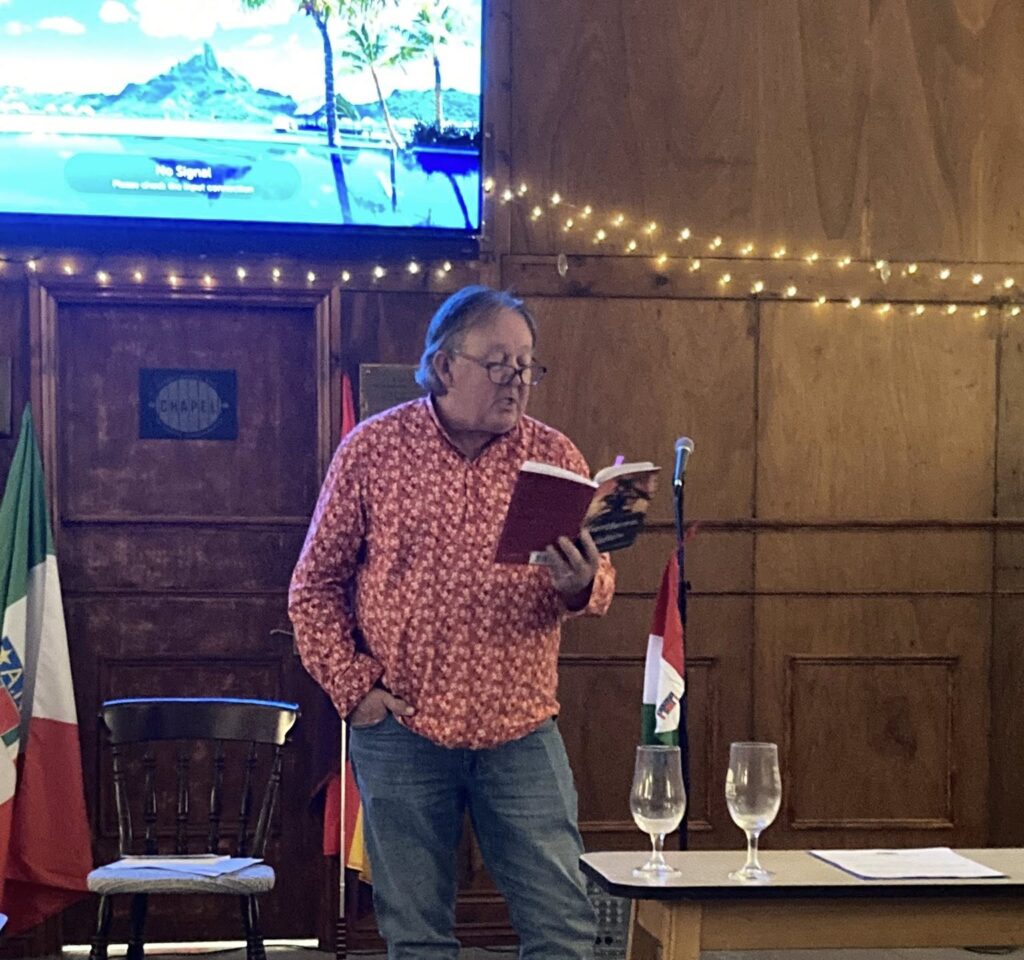
 Bob Beagrie also could not be with us, as he was reading from his latest publication The Hand of Glory in Whitby, he sent his best wishes and asked that I read A Particular Shade of Red from his anthology Romanceros – Romanceros – Bob Beagrie — Drunk Muse Press
A Particular Shade of Red
(After the testimony of Fred Copeman – Reason in Revolt)
“Our children are not taught their history
And you forget them at your peril
For though you fight as well as they
You’ll be betrayed as we were.”
I Have Lived in a Time of Heroes – David Marshall
Not the red of the setting sun licking the tip of the hilltop over the Ebro,
nor the dribble of red vino down the side of a glass raised in a toast to Liberty in a café in Albacete,
it wasn’t the red cross of St George who on this occasion had shrunk away from the Dragon,
not the glowing pool of an illuminated pavement in the Parisian Red-Light District where he’d had a medical examination and been interviewed to check his political orientation,
nor was it the shade of the ‘Red Express’ that shunted him and his comrades south through France,
nor the red field of the communist flag or the emblem of the three pointed star,
it was not the flash of a sol-splashed muleta passing over the horns of a wounded bull,
it wasn’t the glorious crimson of wild roses at the edge of Thornaby Wood,
nor that of paper poppies in lapels on Armistice Day or the real ones growing between crosses on Flanders Fields;
no this particular red followed a quiet pop as a small hole appeared in George Bright’s forehead in the moment before his body dropped.
Bob Beagrie
I had the honour to finish with this message from Jane and Rob Peutrell
George Bright, the Teesside Volunteer, is our grandmother’s step-brother; her father George McLean and George’s mother, Mary were friends who married when both were bereaved early. Our mother remembers, as a child, visiting George’s sister in Stockton, where her mother was born.
Today, we look back at the heroism of the volunteers of many nations who mobilised to fight fascism in Spain.
We remember that for so many of that generation, rising fascism demanded an urgent international struggle. They knew first hand where the politics of hate and scapegoating of easy targets can lead us. There is a slippery slope.
We recall Martin Niemöller confessional words that start ‘First they came …’ and remember how that ended: His words were a demand for solidarity and for acting on the threat we share in common.
Fascism does not start only with jack boots and uniforms.
It starts by peeling away our capacity for solidarity and for recognising what we share despite our differences in colour, religion, sexuality, countries of origin, or how we got here.
Today’s scapegoats are likely to be asylum seekers and members of Muslim communities, or those protesting the genocide in Gaza.
Against the background of the systemic neglect of our communities – the loss of whole industries and skilled, secure work – the gangsters and grifters, the racists and reactionaries are out in force again, as they were in the 30s.
Whether Raising the Colours or wearing suits in Reform, the same bleak forces are slouching around. A party led by millionaires claiming to speak for working class voters.
Cos-play patriots with no programme – and no interest in finding answers to the real problems we all face together – economic insecurity, broken public services, staggering inequalities of wealth and power.
Today, we remember the volunteers, and the struggle and sacrifice of those who – like George and his comrades – united to fight fascism in Spain. Why did they go? From the Stockton memorial:
‘They went because their open eyes could see no other way’.
Solidarity. La lucha continua!



 Alfio
Alfio 


 The American section of 20th International Battalion, Possibly Robert Traill standing first from the right


 Daily Worker, 29th July 1937 –


 7 Alma Place, North Shields


 The Golden Smog, Stockton-on-Tees


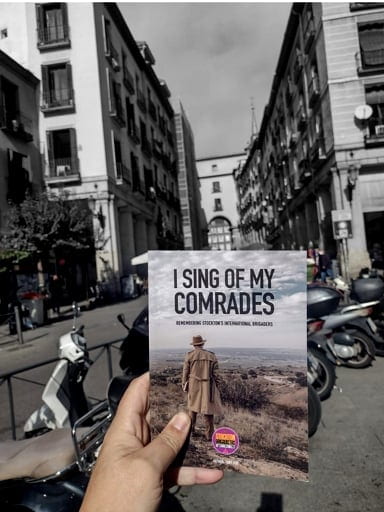 A copy of I sing of my Comrades in Madrid